How a Moped Scooter Hub Motor Works: Principles, Pros and Trade-Offs
Hub motors have quietly become the default drivetrain on modern electric mopeds and scooters. Instead of an engine bolted to the frame driving a wheel through a chain, the motor is built directly into the hub of the wheel itself. The result is a cleaner-looking vehicle with fewer parts to buy, adjust or break. But how does a motor inside a wheel actually turn electricity into motion — and where are its limits? This article walks through the working principle step by step, then weighs the advantages against the trade-offs buyers should know about.
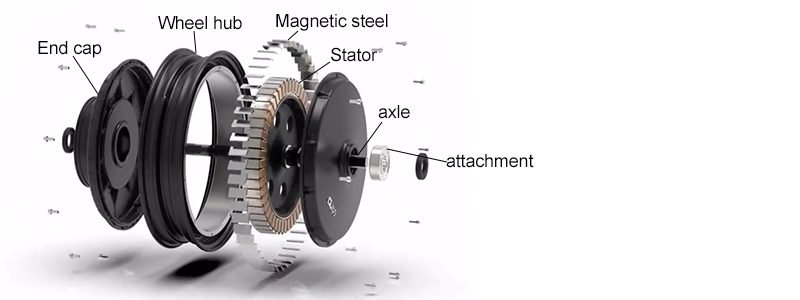
How a moped scooter hub motor works
A hub motor is a compact brushless electric motor packaged inside the hub of the front or rear wheel. Because the motor, wheel and axle are one unit, there is no transmission, chain or belt — and the vehicle gains better weight distribution and simpler maintenance than any chain-driven design.
The motor works on the principle of electromagnetism, and it has two core parts:
- The stator is the stationary component: a stack of copper wire coils wound around an iron core, connected to the battery through the controller. When current flows, the coils generate a magnetic field.
- The rotor is the rotating part, carrying an array of permanent magnets arranged around its circumference and fixed to the wheel.
When power is applied, the magnetic field from the stator coils pushes and pulls the permanent magnets on the rotor, making it spin — and the wheel spins with it. Because the coils are energised in a carefully timed sequence, the rotor keeps chasing the rotating magnetic field, producing smooth, continuous torque from a standstill up to top speed.
The third key player is the controller. It regulates how much current flows through each stator coil and when, which determines the strength and direction of the magnetic field. Twist the throttle and the controller increases current and torque; release it and the field weakens. Precise current control is what gives a hub motor scooter its smooth, responsive acceleration — and it is why controller quality matters as much as motor quality. (For a deeper look, see our guide to moped scooter hub motors and controller matching.)
Advantages of hub motor scooters
- Compact, integrated design. With the motor inside the wheel, there is no drivetrain taking up frame space. Scooters get a slim silhouette and a lower centre of weight, which makes them easier to handle and park.
- Direct-drive efficiency. Power reaches the wheel without passing through gears or chains, cutting transmission losses and delivering instant torque from zero rpm — ideal for stop-and-go city traffic and gentle inclines.
- Low maintenance and high durability. The motor is sealed inside the hub against dust, water and debris, and there are no belts or chains to stretch, lubricate or replace. Fewer wear parts mean fewer warranty claims and a smoother ownership experience.
Limitations to consider
Honesty about the trade-offs builds trust with customers. First, hub motors are size-constrained: everything must fit inside a wheel, so peak power and sustained climbing ability are lower than a comparable mid-mounted system. Heavy riders and long steep grades demand a properly sized motor — see the higher-output options in our electric motorcycle motor range for such use cases. Second, the motor adds unsprung weight to the wheel, which can affect suspension response and ride comfort on rough roads; a well-damped scooter largely cancels this out on typical urban surfaces.
Neither limitation matters much for the classic moped use case — commuting at moderate speeds on city streets — which is exactly why hub motors dominate that segment.
The bottom line
A moped scooter hub motor converts battery current into wheel rotation through the interaction of a wired stator and a magnet-carrying rotor, with the controller acting as the precision throttle between them. The design trades peak power for simplicity, silence and near-zero drivetrain maintenance — a trade most urban riders are happy to make. If you are selecting a motor for a scooter model or a fleet, browse our complete hub motor catalogue or contact the factory for a controller-matched recommendation.